
Evolution of Indian Stock Exchanges: From the Bombay Stock Exchange to the National Stock Exchange and Contemporary Trading Practices
Overview of the Evolution of Indian Stock Exchanges
The trajectory of Indian stock exchanges epitomizes the metamorphosis of the country's financial landscape, transitioning from informal securities trading to a sophisticated, technology-infused marketplace. Over the years, these exchanges have been instrumental in empowering enterprises to secure capital, facilitating securities transactions for investors, and fostering the maturation of India’s capital markets.
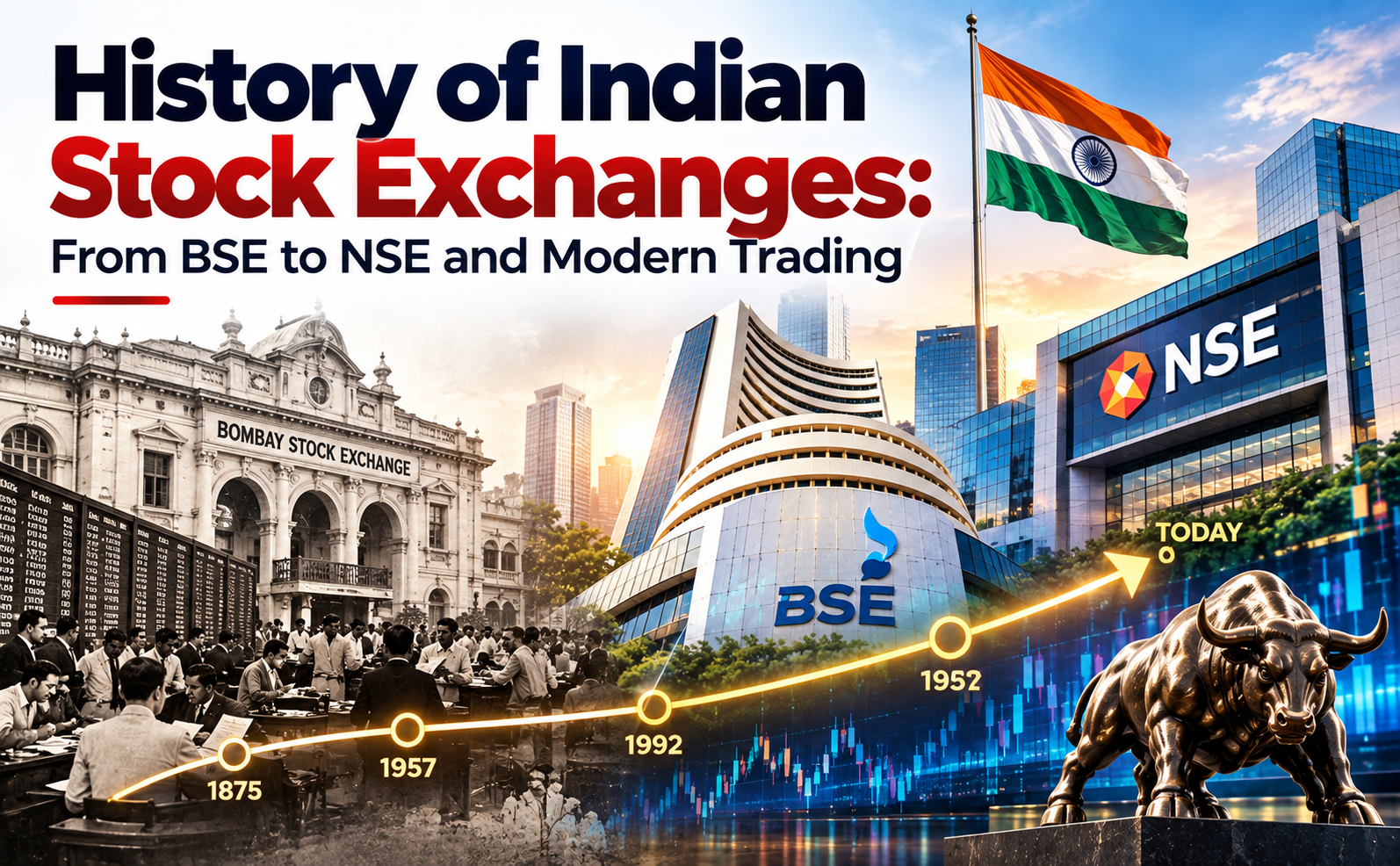
The inception of the Bombay Stock Exchange (BSE) in 1875 marks a pivotal milestone in this journey. Subsequently, the National Stock Exchange (NSE), incorporated in 1992 and commencing trading in 1994, revolutionized the market by introducing a comprehensive electronic trading system that dramatically altered the dynamics of securities trading throughout India.
User-centric regulatory reforms, advancements in electronic trading systems, the introduction of dematerialized securities, and enhancements in market infrastructure have collectively rendered the Indian stock market more accessible and transparent. A nuanced understanding of this evolution lays the groundwork for comprehending IPOs, market indices, listed entities, and the overall mechanics of the stock market.
The Genesis of the Indian Stock Market
The genesis of formalized securities trading in India can be traced back to the bustling economic milieu of nineteenth-century Bombay, now known as Mumbai. During this era, burgeoning economic activities and the proliferation of commercial ventures spurred interest in trading shares and various financial instruments.
Prior to the establishment of formal exchanges, brokers facilitated transactions through loosely organized groups and informal associations. As the volume of trading increased, the necessity for a structured marketplace with established protocols became increasingly apparent.
In 1875, a coalition of brokers formally founded the Native Share and Stock Brokers' Association in Bombay, laying the groundwork for what is now recognized as the Bombay Stock Exchange. This development was a significant stride toward establishing structured securities trading in India.
Bombay Stock Exchange (BSE): The Dawn of Organized Trading
The Bombay Stock Exchange (BSE), established in 1875, is lauded as Asia's oldest stock exchange. Its evolution is intrinsically linked to the expansion of India's commercial and industrial economy.
Over the years, the exchange has fostered a more formalized environment for trading shares and securities, emerging as a crucial platform for businesses seeking investment and for market participants engaged in the buying and selling of listed securities.
Pivotal Developments in BSE History
- 1875: The Native Share and Stock Brokers' Association was officially inaugurated in Bombay.
- Late 19th century: Organized trading activities flourished alongside the growth of commercial and industrial enterprises.
- 20th century: BSE enhanced its trading infrastructure, becoming a cornerstone institution in India’s securities domain.
- Modern era: The advent of electronic systems radically transformed trading practices, supplanting traditional floor-based operations with expeditious computer-based transactions.
As a vital player in the evolution of India's capital market, BSE has provided a platform for both listed companies and investors, while also managing benchmark indices that illuminate price movements of selected stocks.
National Stock Exchange (NSE): A Paradigm Shift in Electronic Trading
The National Stock Exchange (NSE) was incorporated in 1992, recognized by the Securities and Exchange Board of India (SEBI) in 1993, and initiated operations in 1994.
NSE pioneered fully automated, screen-based trading in India, transitioning from physical trading floors dependent on broker interactions to an electronic system enabling investors and trading members to place orders directly online.
This technology-centric model significantly broadened market access across the nation, optimized the matching of buy and sell orders, and enhanced transparency in price discovery.
Landmark Milestones in NSE Evolution
- 1992: NSE was incorporated.
- 1993: NSE received recognition as a stock exchange from SEBI.
- 1994: NSE initiated operations in the wholesale debt market and subsequently launched its equity trading segment via electronic systems.
- 1996: The Nifty 50 index was unveiled, serving as a benchmark for tracking the performance of large enterprises listed on the NSE.
- 2000: NSE introduced index options based on the Nifty index, thereby extending its derivatives product offerings.
- Subsequent years: The evolution of online trading, mobile access, novel financial products, and technological enhancements persistently improved the exchange's offerings.
The establishment of the NSE has profoundly reshaped the landscape of Indian securities trading, fostering a more accessible and technology-driven market infrastructure.
The Formation and Function of SEBI
The Securities and Exchange Board of India (SEBI) serves as the principal regulatory authority overseeing India's securities market. Originally constituted in 1988, SEBI attained statutory status under the SEBI Act of 1992.
As India's capital markets progressed, the imperative for effective regulation became crucial for safeguarding investors, ensuring orderly trading, and fostering transparent market practices. SEBI's mandate encompasses regulating market participants and exchanges, ensuring compliance with relevant regulations, and safeguarding investor interests.
Regulatory improvements have established a comprehensive framework for public offerings, disclosure protocols, market conduct, and the operations of financial intermediaries, which are particularly salient for investors engaging in IPOs and trading listed securities.
For detailed information regarding the regulator's functions and responsibilities, please refer to the SEBI website.
Transition from Physical Trading to Electronic Markets
One of the most groundbreaking advancements in the history of Indian stock exchanges has been the evolution from traditional floor-based trading to a fully electronic trading paradigm.
In earlier trading environments, brokers convened on exchange floors to negotiate and finalize transactions. While this methodology facilitated organized trading, it was encumbered by limitations concerning geographical reach, speed, and the accessibility of market intelligence.
Electronic trading revolutionized this paradigm with computer-based order placement and matching, allowing investors to access the market via registered trading members without necessitating physical presence at the exchange.
Significant enhancements associated with electronic trading include:
- Accelerated order execution: Automated processes significantly expedited the matching of orders.
- Expanded market access: Trading capabilities became accessible to participants in diverse locations.
- Enhanced price transparency: Electronic systems improved accessibility to market prices and order information.
- Advanced monitoring: Digital records and surveillance systems enhanced the oversight of trading activities.
- Rise of online investing: Internet-based platforms and mobile applications facilitated easier access to market services through registered brokers.
This transition has laid the foundation for the technology-driven stock market utilized by investors today.
Dematerialization: The Leap to Electronic Securities
Another pivotal advancement has been the advent of dematerialized securities, commonly referred to as demat holdings. Prior to dematerialization, investors typically held shares in physical certificate form, which posed challenges such as cumbersome paperwork, transfer delays, and the risks of lost, damaged, or counterfeit certificates.
Dematerialization empowered securities to be held electronically through depositories and their participants, with the establishment of the National Securities Depository Limited (NSDL) in 1996 representing a landmark achievement in this transition.
This electronic framework simplified the transfer of securities and facilitated more efficient settlement processes. Presently, investors predominantly utilize demat accounts for electronic holdings of eligible securities, while trading accounts are employed for order placements with registered brokers.
The Evolution of Significant Indian Stock Market Indices
Stock market indices serve as vital analytical tools for investors, providing insights into the performance of a curated group of securities. They function as benchmarks for assessing market movements and evaluating investment performance.
BSE Sensex
The BSE Sensex, a benchmark index associated with BSE, tracks a carefully selected group of major companies listed on the exchange, and is widely regarded as a barometer of movements within India’s equity market.
Nifty 50
The Nifty 50, a flagship benchmark index linked to NSE, was introduced in 1996 to represent a selection of large, actively traded companies across various sectors of the Indian economy.
Both indices are extensively utilized by investors, analysts, and financial media to gauge market trends; however, it is essential to acknowledge that an index's performance does not necessarily reflect the returns of all listed stocks or individual investors' portfolios.
The Surge of IPOs and the Indian Primary Market
As stock exchanges and their infrastructure have matured, the Indian primary market has emerged as a crucial avenue for companies seeking to raise funds from public investors.
An Initial Public Offering (IPO) enables a company to issue shares to the public and, contingent upon fulfilling applicable requirements, pursue listing on a stock exchange. IPOs provide companies with capital for expansion, debt repayment, implementation of business strategies, or an exit vehicle for existing shareholders through an Offer for Sale.
Contemporary IPO processes incorporate electronic applications, comprehensive disclosures, subscription reporting, allotment procedures, and exchange listing, allowing investors to scrutinize various types of information prior to engaging in a public offering.
- IPO subscription data enables investors to assess demand across various investor segments.
- IPO allotment status provides applicants with the ability to verify the outcome post-allotment.
- IPO market analytics offers insights into IPO activities and correlated market dynamics.
- IPO listing performance facilitates the examination of historical listing outcomes and trends.
These indicators fulfill distinct purposes and should be interpreted in conjunction with a company's offer documents, financial standing, valuation, and associated risks. Historical performance of listings should not be construed as a guarantee of future IPO outcomes.
Current Operations of Indian Stock Exchanges
Today, India’s stock market functions through a comprehensive network of exchanges, brokers, clearing corporations, depositories, and other regulated entities. The BSE and NSE are the foremost equity exchanges in the country, both offering trading avenues for eligible securities in accordance with prevailing regulations.
The modern trading process typically encompasses the following steps:
- Account establishment: Investors initiate trading and demat accounts through registered service providers.
- Order initiation: Investors submit buy or sell orders via the broker’s trading platform.
- Order matching: The trading system of the exchange matches compatible buy and sell orders in accordance with its established protocols.
- Clearing and settlement: The pertinent clearing and settlement infrastructure processes the transaction along with the transfer of funds and securities.
- Electronic holdings: Securities acquired by investors are credited into their respective demat accounts post-settlement.
Exchanges play an integral role in market surveillance, risk management, and the dissemination of trading information, all of which are crucial for maintaining orderly markets and fostering investor confidence.
Challenges and Ongoing Developments
Despite substantial advancements in market frameworks, Indian stock exchanges continue to navigate an ever-evolving environment characterized by technological advancements, varied levels of investor participation, regulatory changes, and global economic influences.
Key areas of ongoing development include:
- Technological resilience: Ensuring the reliability of trading systems and safeguarding market infrastructure against potential technical disruptions.
- Investor education: Empowering market participants to comprehend financial products, market risks, and the significance of informed decision-making.
- Market oversight: Vigilantly monitoring atypical trading activities and enforcing regulatory compliance.
- Digital accessibility: Advancing access to financial data and trading services via online and mobile channels.
- Innovative financial products: Encouraging the development of qualified investment and risk-management instruments within the context of regulatory compliance.
As participation and technology continue to evolve, exchanges and regulators must maintain a delicate balance between innovation, market efficiency, and investor protection.
Frequently Asked Questions
Which is the oldest stock exchange in India?
The BSE, originally founded as the Native Share and Stock Brokers' Association in 1875, is esteemed as India’s oldest stock exchange and the oldest in all of Asia.
When was the National Stock Exchange established?
The NSE was incorporated in 1992, recognized as a stock exchange in 1993, and commenced its trading operations in 1994.
What role did the NSE play in the advancement of India's stock market?
The NSE catalyzed the transformation of Indian securities trading by instituting automated screen-based trading and broadening access to electronic markets nationwide.
When was SEBI established?
SEBI was initially constituted in 1988 and attained statutory authority in 1992 under the SEBI Act.
What distinguishes the BSE Sensex from the Nifty 50?
The BSE Sensex serves as a benchmark index associated with the BSE, whereas the Nifty 50 functions as the flagship benchmark index linked to the NSE. Both indices monitor selected companies and facilitate the assessment of wider trends in the Indian equity market.
Why is dematerialization critical for Indian stock exchanges?
Dematerialization allows for the electronic holding and transfer of securities, diminishing reliance on physical certificates and bolstering the efficiency of securities transactions.
Do stock exchanges guarantee profits for investors?
Negative. While stock exchanges offer regulated trading platforms, they do not assure investment returns. Share prices can be volatile, and investors risk losing part or the entirety of their invested capital.
Conclusion
The chronicles of Indian stock exchanges delineate the evolution of the country’s financial markets, transitioning from informal broker associations to structured exchanges fortified by electronic trading and modern market infrastructure.
The establishment of the BSE in 1875 laid the essential groundwork for organized securities trading, while the NSE's introduction of electronic trading in the 1990s, along with the establishment of SEBI's regulatory framework and the promotion of dematerialized securities, radically reshaped the market landscape.
In contemporary times, stock exchanges play an indispensable role in capital formation, price discovery, and securities trading. A thorough understanding of their historical journey equips investors with the insights necessary to comprehend the intricacies of IPOs, listed shares, benchmark indices, and the broader facets of the Indian financial ecosystem.
Disclaimer: This article serves an educational purpose only and should not be construed as investment advice or a recommendation to acquire or dispose of any securities.